Media
Coverage
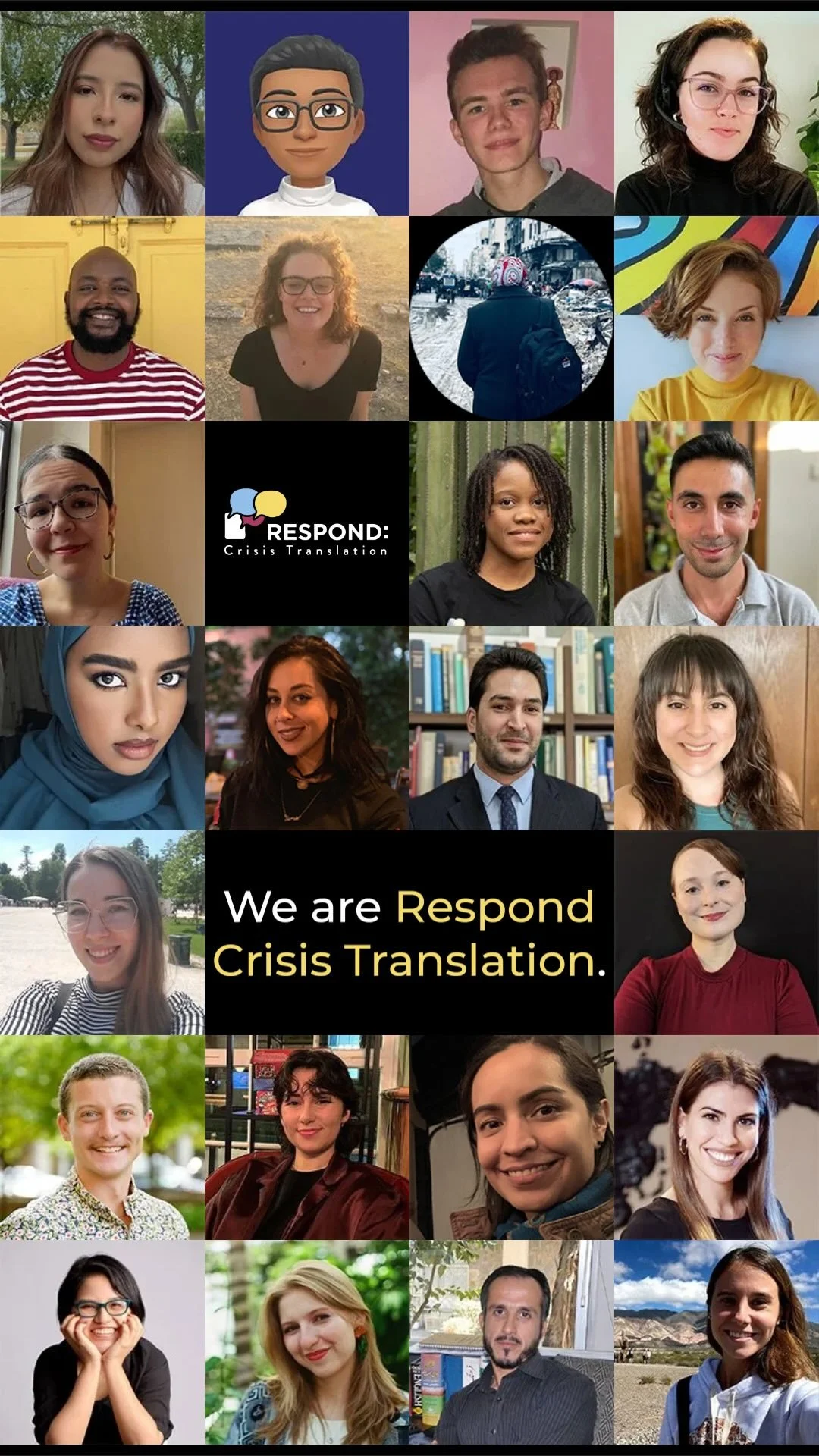
Respond is a language justice collective mobilizing around-the-clock to help people access basic human rights.
Read stories by and about or team, find news coverage of our work, access our announcements and job vacancies, and connect with our communications team.
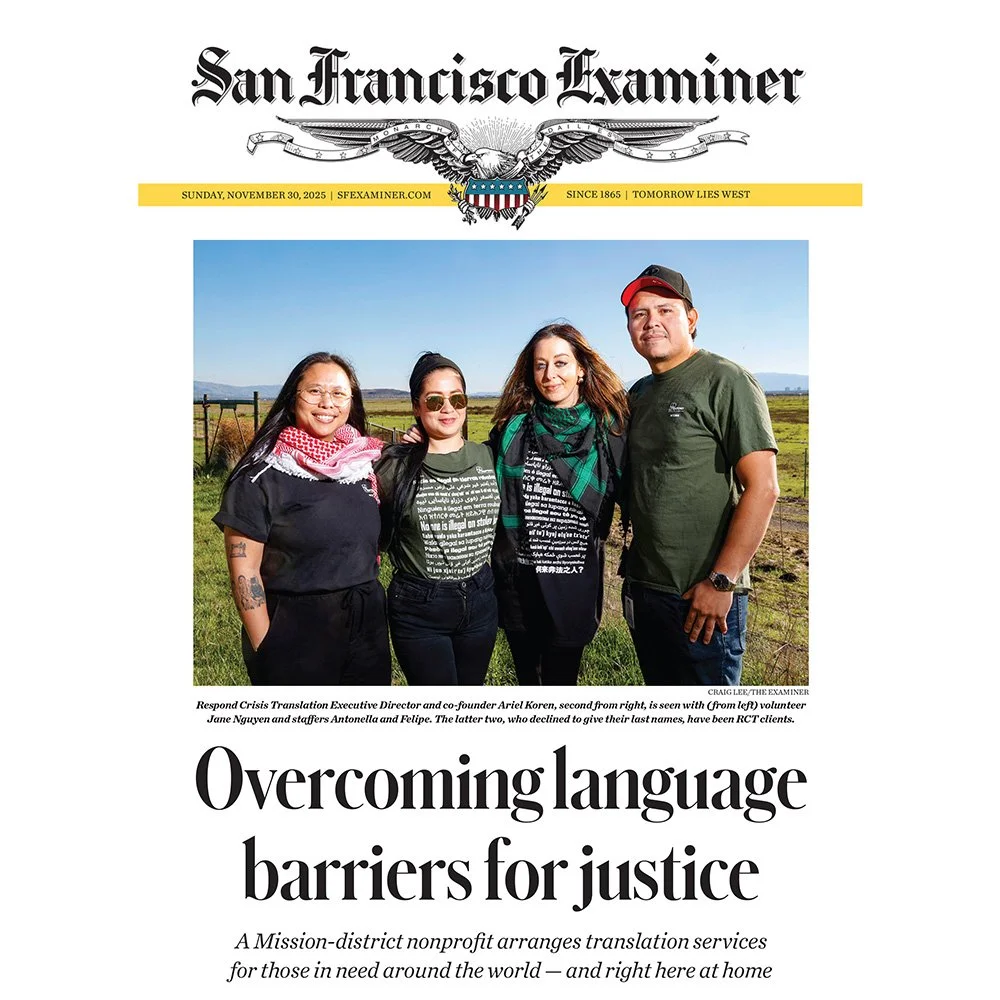
Felipe’s first interview a year earlier had been rescheduled because he didn’t have an interpreter with him, he said. He hadn’t known at the time that U.S. Citizenship and Immigration Services requires asylum applicants to provide their own interpreters and can throw out their cases if they don’t.
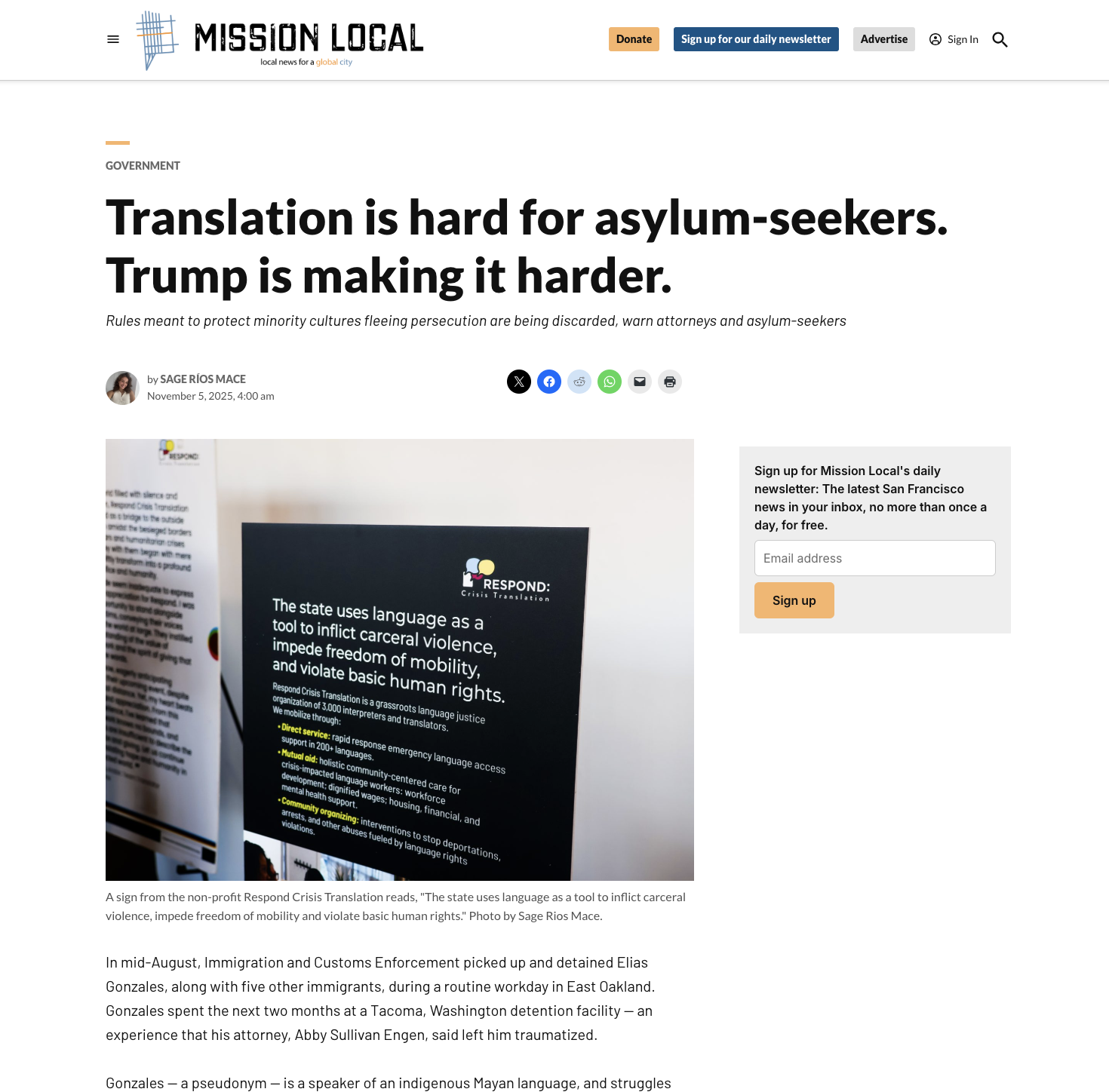
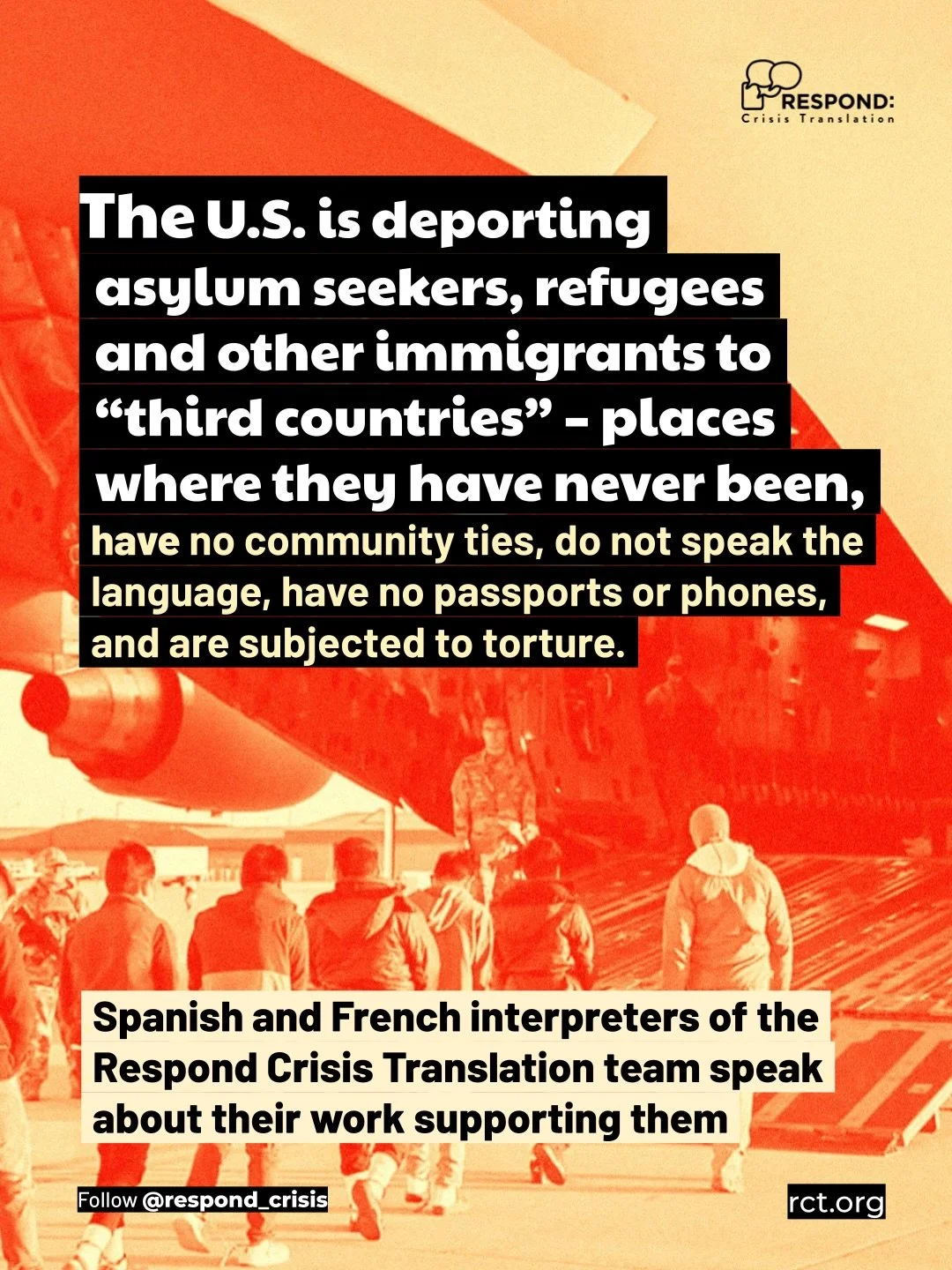
At our language Justice Forum at the Mission Cultural Center for Latino Arts in San Francisco on Oct. 30, we discuss the targeting on asylum seekers with language violence and language access. It was covered by Mission Local.
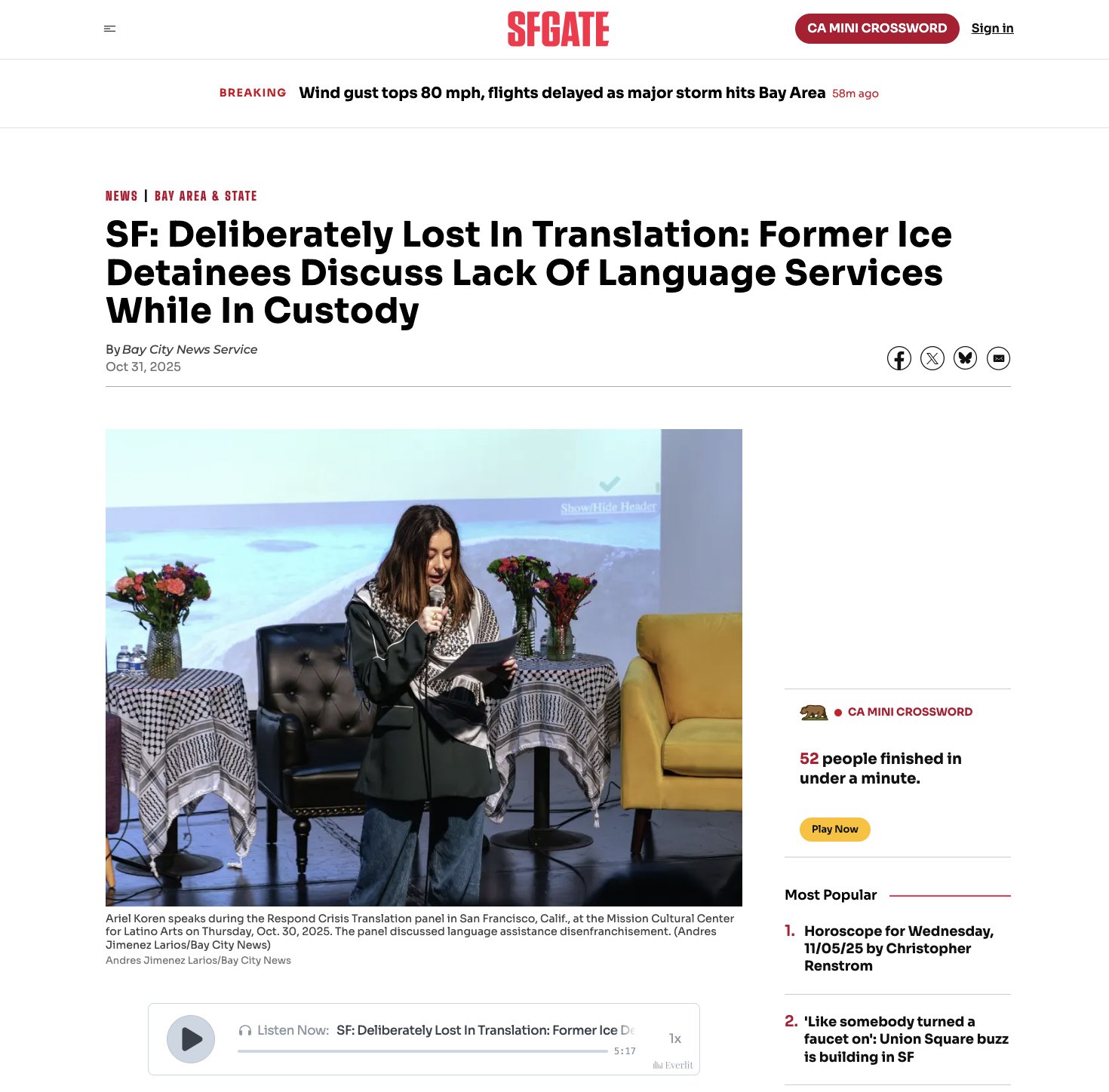
Last Thursday, Oct. 30, RCT held a panel at the Mission Cultural Center for Latino Arts in San Francisco to talk about language depravation and it was covered by the SFGATE media.
Ayah Najadat, Language activist, translator and former RCT Arabic team lead, has published in Aljazeera a reflection on her work as an interpreter with RCT and the contrast as many countries recognise Palestine but treats its refugees as stateless …
Over a year later, Alice Knight-Garcia from independent UK-based West Country Voices looks back on Respond’s feature in The Guardian ‘Lost in AI Translation’, shedding light on the growing concern surrounding the use of Artificial Intelligence, …
Linguists with Respond Crisis Translation participated in interviewing and sharing their expertise in this research article titled “Held Incommunicado: The Failed Promise of Language Access in Immigration Detention.”
Respond Crisis Translation Arabic team feature in THE LINGUIST.
Miranda Moore explores the work of translators both inside and outside Gaza, and the difficulties they face.
Respond Crisis Translation’s Co-founder and Director of Operations Meg Sears recently appeared on a panel hosted by Comma Press at Manchester in Translation on decolonizing translation, alongside UCL Professor of Translation Studies Kathryn Bachelor, writer, editor, researcher and translator Dr Kavita Bhanot.
Rudaw, a major publication in Iraqi Kurdistan, featured Respond Crisis Translation’s Kurdish storytelling project, “One year since the quake: Linguicide and resilience of the Kurdish language.”
Even though the media extensively covered the Turkey-Syria earthquake that killed more than 59,000 people exactly one year ago ...
Respond’s founder and executive director Ariel Koren joined KJZZ, the National Public Radio member station in Phoenix, Arizona, to talk about a new rule requiring asylum seekers to bring their own interpreters during USCIS interviews
IN CASE YOU MISSED IT: Respond Crisis Translation’s unmasking of the dangers and ills of unsupervised reliance on AI and machine translation tools in the U.S. asylum and immigration context was featured in Futurism’s The Byte and on The World from PRX’s Things That Go Boom podcast.
While working tirelessly around the clock to provide life-saving translation and interpretation on the front lines of crises across the globe, Respond has also driven coverage on issues of language justice throughout 2023.
Bloomberg Businessweek describes how Respond has become a primary lifeline for many migrants and advocates at the U.S.-Mexico border, especially as private companies contracted by the U.S. government fail to provide adequate translators and interpreters.
On Saturday, November 25, a clip posted by BBC News showed a released Palestinian prisoner describing horrific abuses inside an Israeli prison. She said, in Arabic, that Israel held them in the cold without electricity, "sprayed us with pepper spray" and “left us to die." …
Respond tells Context about how “insane” machine translation errors are jeopardizing U.S. asylum claims. Names translated as months of the year, incorrect time frames and mixed-up pronouns – the everyday failings of AI-driven translation apps are causing havoc in the U.S. asylum system, with our human translators left to clean up the mess.
Respond Crisis Translation shared with The Guardian about how the U.S. government’s growing reliance on unsupervised machine translation to cut costs has jeopardized several asylum applications.
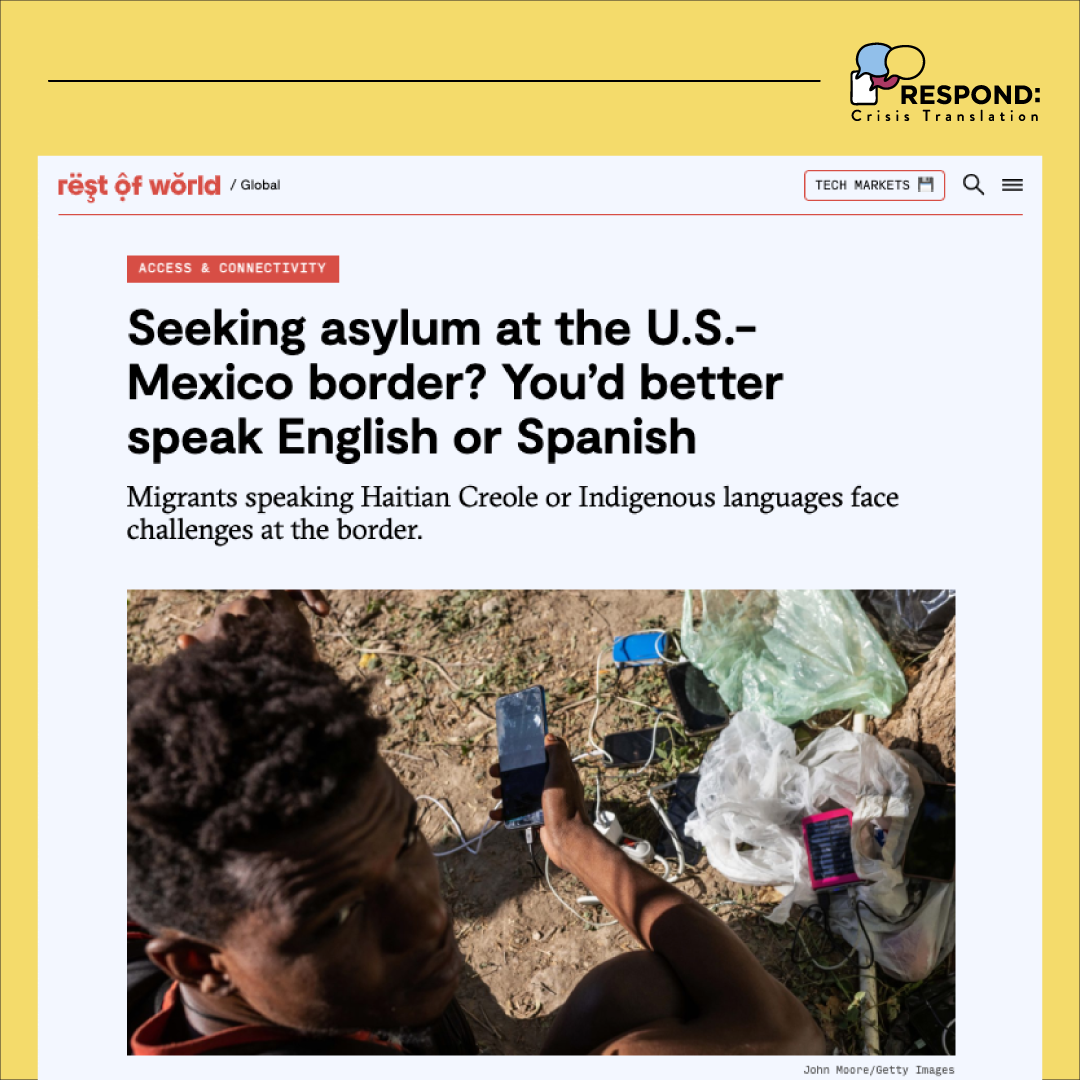
Respond Crisis Translation’s Valentina Callari Lewis writes that asylum seekers who speak Indigenous and marginalized languages are regularly deprived of their fundamental human right to quality translation services at the US border.
Language violence against asylum seekers on the border is increasing. All asylum seekers are now required to use the government’s new glitchy CBP One Mobile App in order to initiate the asylum process. It is only partially accessible in 5 poorly translated languages. As our Haitian Creole Team Lead recounts in the article…
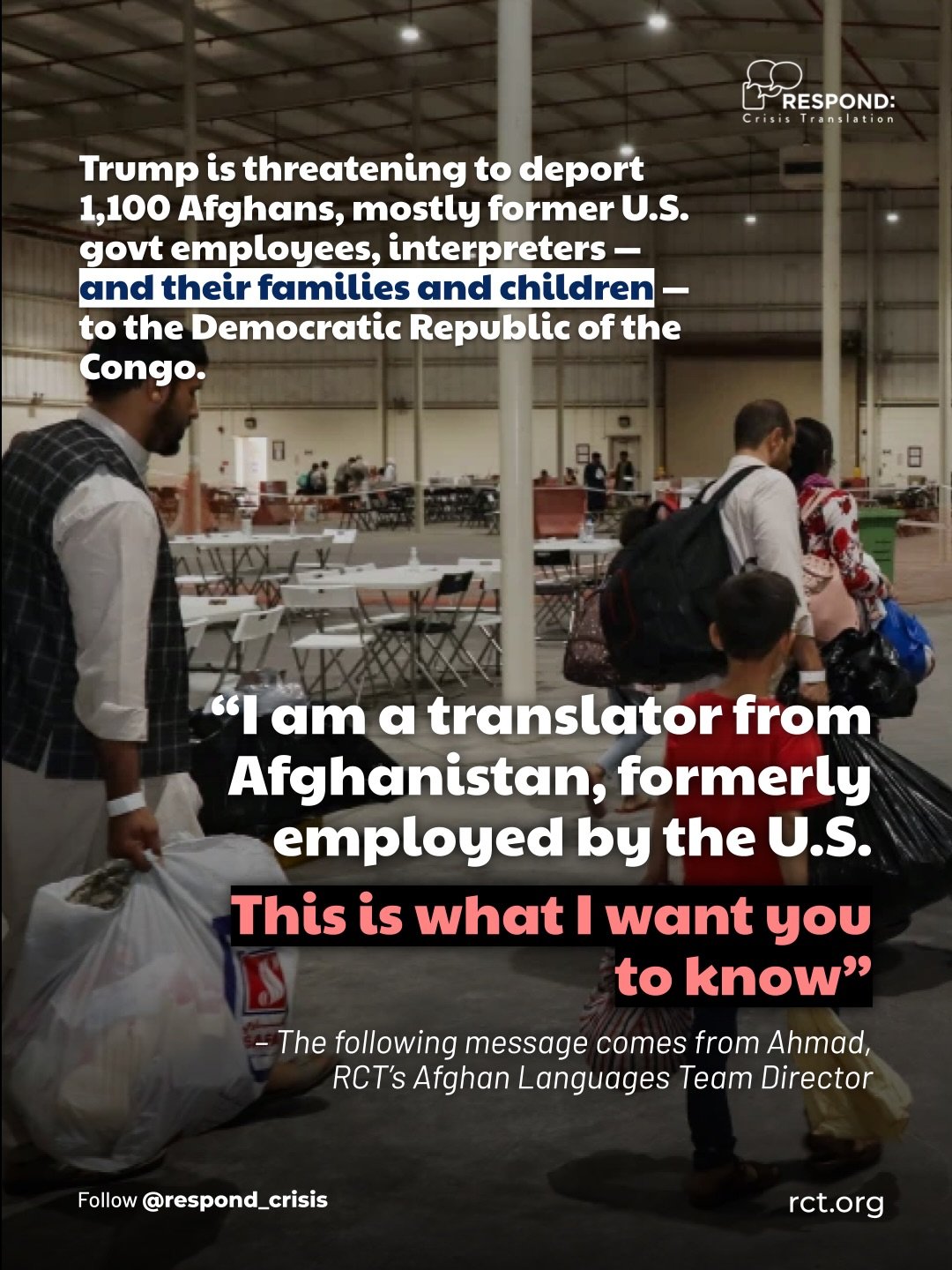
Machine translation is on the rise. For-profit government contractors and aid organizations are increasingly adopting these tools to cut costs. This not only costs translators their jobs, but is quite literally jeopardizing Afghans’ asylum cases. The error-riddled translations in Dari, Pashto, and countless other languages…
“Machine translations of Pashto and Dari, in particular, are riddled with errors that have introduced confusion into already complex immigration processes, and led to the rejected asylum claim of at least one Afghan refugee.”
“I wanted to write a story about the earthquake that was also about ordinary people and everyday life. I wanted my characters to have complex interior lives, and have ordinary joys, concerns, relationships, and dreams, because as we all know there’s a kind of flattening and dehumanization that happens in a lot of …
by Talia Lavin
Insofar as the war in Ukraine is a war about anything, it is a war about language—a war whose ludicrous justification by Vladimir Putin is in part based on the utterly false claim that the Russian language, and its speakers, have been systematically repressed, to the point of genocide, by a merciless, fascist Ukrainian regime…
An article in Mother Jones covers Respond’s work defending a client who was denied access to an interpreter even in spite of requesting translation support over ten times while critically ill in detention.
Journalist Yula Rocha has written about Respond Crisis Translation in the Stanford Social Innovation Review. She interviewed Respond´s Ariel Koren and Fernanda de Oliveira as well as Respond partners Aida Farahani, attorney at RAICES, and Leticia Morales, Founder of Texas Nicaraguan Community.
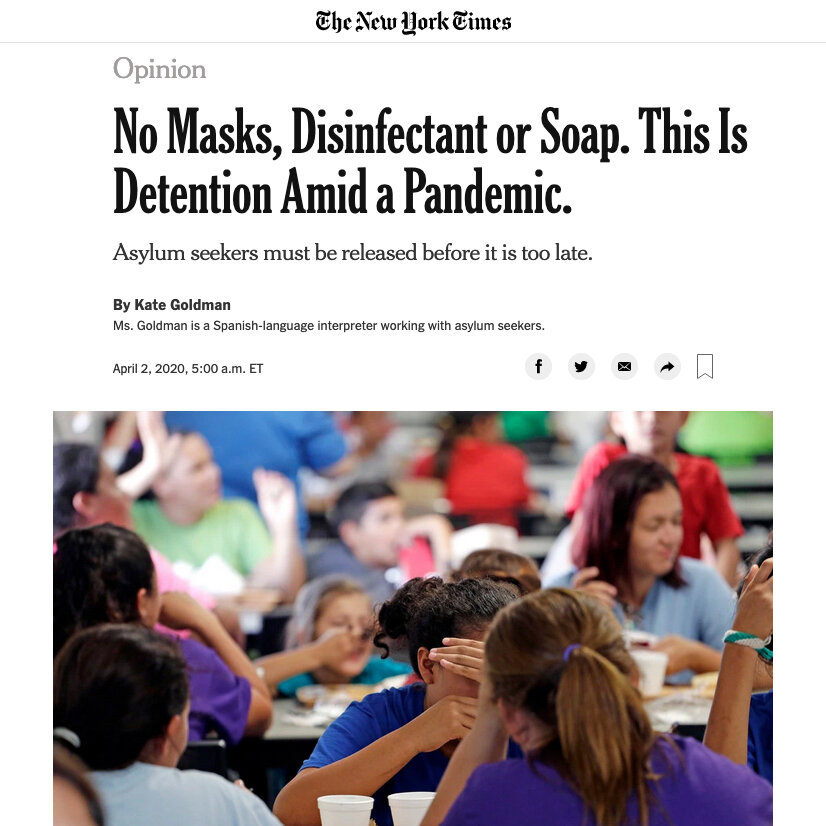
One of our volunteer translators Kate Goldman today is published in the New York Times where she discusses the urgency of her language access work with Respond Crisis Translation in addition to ICE´s responsibility to …
FOR MEDIA PROFESSIONALS Contact our media team
If you are a member of a news or media organization and need assistance, contact us at media@respondcrisistranslation.org