
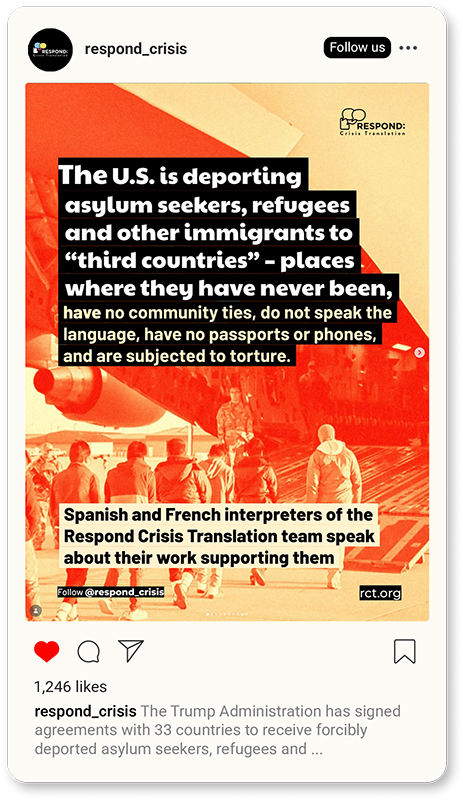
The U.S. is deporting asylum seekers, refugees and other immigrants to “third countries” – places where they have never been
The U.S. is deporting asylum seekers, refugees and other immigrants to “third countries” – places where they have never been, have no community ties, do notspeak thelanguage, have nopassports or phones,and aresubjected to torture.
Spanish and French interpreters of the Respond Crisis Translation team speak about their work supporting them.
“On April 17th, 2026, 15 people from Peru, Colombia, and Ecuador were forcibly deported from the U.S. to the Democratic Republic of the Congo. These third-country deportations use linguistic and cultural deprivation to cause mental and physical terror. As politiczed interpreters, we are mobilizing against these efforts to bury people in linguistic, cultural, and geographic isolation.”
– Aymeric, RCT French Team Lead
“One Colombian woman, who was tortured by police officers in Colombia and granted protection under the Convention Against Torture (CAT) in the United States, was sent to the DRC after being held by ICE for over a year in detention and a failed attempt to deport her to Mexico.
A Colombian man sent to the DRC had lived in the United States for eight years and is now separated from his wife and four children in Florida.”
– ThirdCountryDeportationWatch.org
The Trump Administration has signed agreements with 33 “third countries” to receive deportees.
People are deported with no warning, no chance to raise fears of persecution, and arrive in a totally unknown country where they don’t speak the language, have no passports or phones, and are vulnerable to mistreatment, detention, and torture.
“While interpreting, it has become clear to me that they have been given no information about the location they have been sent to and why they were sent there to begin with.”
– Raquel, RCT Spanish Team Lead
“They locked me in a room, they didn't give me food or water. It was very cold… I didn't appear in the system because I was never prosecuted… I told them I was afraid because of the insecurity and they didn't respond, and well, here I am, in Congo.
How do I feel now? Well, I feel that our human rights have been violated… There’s a lot of misinformation on social media; they're saying we're criminals and that we deserve what's happening to us. That’s not right.
The lack of information here and not knowing what's going to happen to us is affecting us emotionally and psychologically…We feel completely adrift. We don’t know what’s going to happen to us.”
– ThirdCountryDeportationWatch.org
“People are trying to navigate immigration systems while living everyday life in a place completely unfamiliar. The people we interpreted for were suddenly in the DRC without knowing the language, the culture, the food, the healthcare system.
The interpretation we provided was not only about court hearings or paperwork, it was also about reassuring scared and vulnerable people, helping them understand where they are, explaining cultural differences, or making sure they can communicate some of the most basic needs. For me, this work is about reducing the isolation they are experiencing. Helping a person to survive and hold onto hope. This is why language work is so crucial.”
– Aymeric, RCT French Team Lead
“Working on these cases reminds me how much being able to communicate even in the small moments Is critical in such Drastically oppressive contexts. When you hear someone laugh, make a joke, or gradually sound more at ease as the conversation moves forward, you Remember that You are amplifying the voices Of those who fight to embodying life and humanity into what many have swept aside as being an abstract abstract political issue.
It also makes you feel useful in a very concrete way: even if you cannot change the larger situation these individuals are facing, being able to Facilitate communication so that people can understand what is happening around them truly makes a difference.”
– Aymeric, RCT French Team Lead
“Translation and interpretation play a political role. When language is used to fuel crimes against humanity, translation must be employed as a bridge to safety.
Safeguarding individuals’ ability to understand and make themselves understood, regardless of where they are or where they are taken, is a responsibility that we cannot ignore. Without this linguistic bridge, no rights can truly be exercised. Access to language is a human right, not a favour.
As language workers from around the world, we express our support for those experiencing this situation and reaffirm that communication is not a privilege. It is a necessary condition to exercise any rights.”
– Raquel, RCT Spanish Team Lead
“Not only is it important to talk about these cases, but also to keep talking about them, now that the initial media attention has faded away.
Through my work with RCT, I hope to remind people that even if the media moved on, they have not been forgotten. We are still listening, doing what they can to help ensure their needs are acknowledged. In a way, it is also about allowing their story to continue being told, even outside traditional media attention.”
– Aymeric, RCT French Team Lead