
RCT interprets for Global Sumud Flotilla
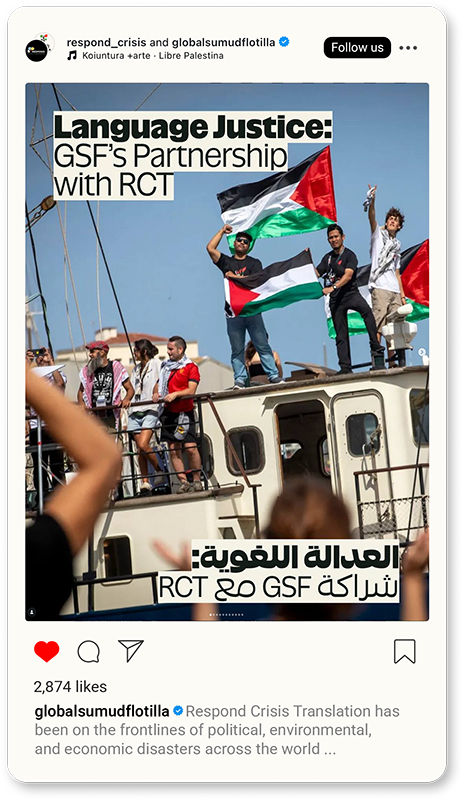
Respond Crisis Translation has been on the frontlines of political, environmental, and economic disasters across the world.
In Gaza, @respond_crisis has provided translation services for people in prison, seeking asylum or accessing remote health services.
There is more to the Global Sumud Flotilla than the people on the boats. Beind the scenes, Respond Crisis Translation (RCT) language workers are central to our movement. RCT stepped in to assist the 2026 Global Sumud Flotilla by providing interpreting services at vital training sessions and translating resources for the thousands of activists involved in the movement.
RCT creates employment for translators living in sites of crisis such as Gaza.
“To be a translator in Gaza means to be a witness to pain and a voice for the survivors. I work under nearly impossible conditions: no electricity, no stable internet connection, no safety, and constant displacement. Yet I carry on, because this work is my way of surviving, of resisiting, and of beliving that my future is still whitin reach.”
“Language is one of the weapons of the occupation and its Zionist co-conspirators to manipulate and tarnish truth and history. As linguists, we take action to provide the correct translation, building power for our narrative and helping the oppressed.”
RCT has worked closely with GSF facilitating translation services for more than a month of training for GSF’ international delegations
“Using language, for me, is a way to amplify Palestinian voices and ensure that our stories are told with dignity and accuracy.
As a Palestinian, it also means resisting erasure, preserving our narratives, and standing in solidarity with our people by making our reality understood across different languages and audiences.”
RCT is mobilizing language support for the GSF, translating resources for the mission’s activists. RCT mobilizes to serve the most marginalised while developing a paid, local workforce on the ground in any crisis.
From Palestine to the Américas, RCT’s language work is more than a direct service or a source of humanitarian aid: it is political struggle against the systemic weaponization of language to inflict state violence and the material and narrative erasure of the language workers who play a central and constant role across every struggle for dignity, justice, and liberation.
Get involved and support RCT’s urgent, frontlines language access work for the Palestinian liberation movement by donating:
bit.ly/rct-donate
For updates about RCT’s work on the ground, follow us and scan the QR code