
Language Workers Fighting Back
Dear RCT community,
While the Trump Administration eliminates protections for asylum seekers across the United States, we are fighting back and resisting.
As asylum applications are subjected to increased scrutiny and over 60,000 people are currently detained by ICE, we are seeing a dramatic increase in immigration detention cases and deportation defense cases, which has reshaped the nature of our work. As the needs on the frontlines shift, our mission remains the same: ensuring that everyone navigating the carceral immigration system has access to language support.
Help us sustain this life-saving work.
Historically, around 60% of our incoming revenue has come from the paid work we do with our 700+ values-aligned partner organizations. However, since Trump 2.0 began, many of these organizations have seen their budgets slashed due to funding cuts and federal grants being withdrawn. For us, this has a knock-on effect: we never say no to a project due to lack of ability to pay, so we are producing a significantly higher amount of pro-bono work for our partners. In order to continue being able to do so, we rely more and more on individual giving and contributed revenue. The work that we do for our partners is more crucial than ever, but we also must continue to cover the operational costs and the rates that we pay out of pocket to our crisis-impacted linguists. If you have the means to contribute so that we can keep this going, please consider donating!

Trump’s inhumane policy of deportations to third countries
This year, we’ve seen a new facet of the border imperialist regime: the Trump administration has entered into third party deportation agreements with over 30 countries. According to our partner Refugees International, more than 17,500 people have been transferred to third countries where they have no family, where they do not speak the language, and which are often unsafe and have little-to-no legal protection for migrants. One such case is that of the Democratic Republic of Congo, where RCT has intervened to ensure that Colombian migrants deported to the DRC had access to interpretation services for their legal proceedings. The interpreter who has been working on the case said:
“Third-country deportations are motivated by linguistic and cultural deprivation: they rely on fear in an unfamiliar environment to break migrants. In this context, interpreters play an essential role in ensuring that migrants are heard and understood across linguistic and cultural barriers.”
The Trump regime wants to break migrants. They want to deprive them of their basic rights to safety and communication. We refuse to let that happen, and our team will continue mobilizing to ensure that anyone who has been a victim of this cruel, illegal and inhumane policy has access to the language services they need.
If you know someone who has been affected by this policy who needs language access services, write to us at admin@rct.org.
Supporting the Global Sumud Flotilla as they sail to break the siege on Gaza
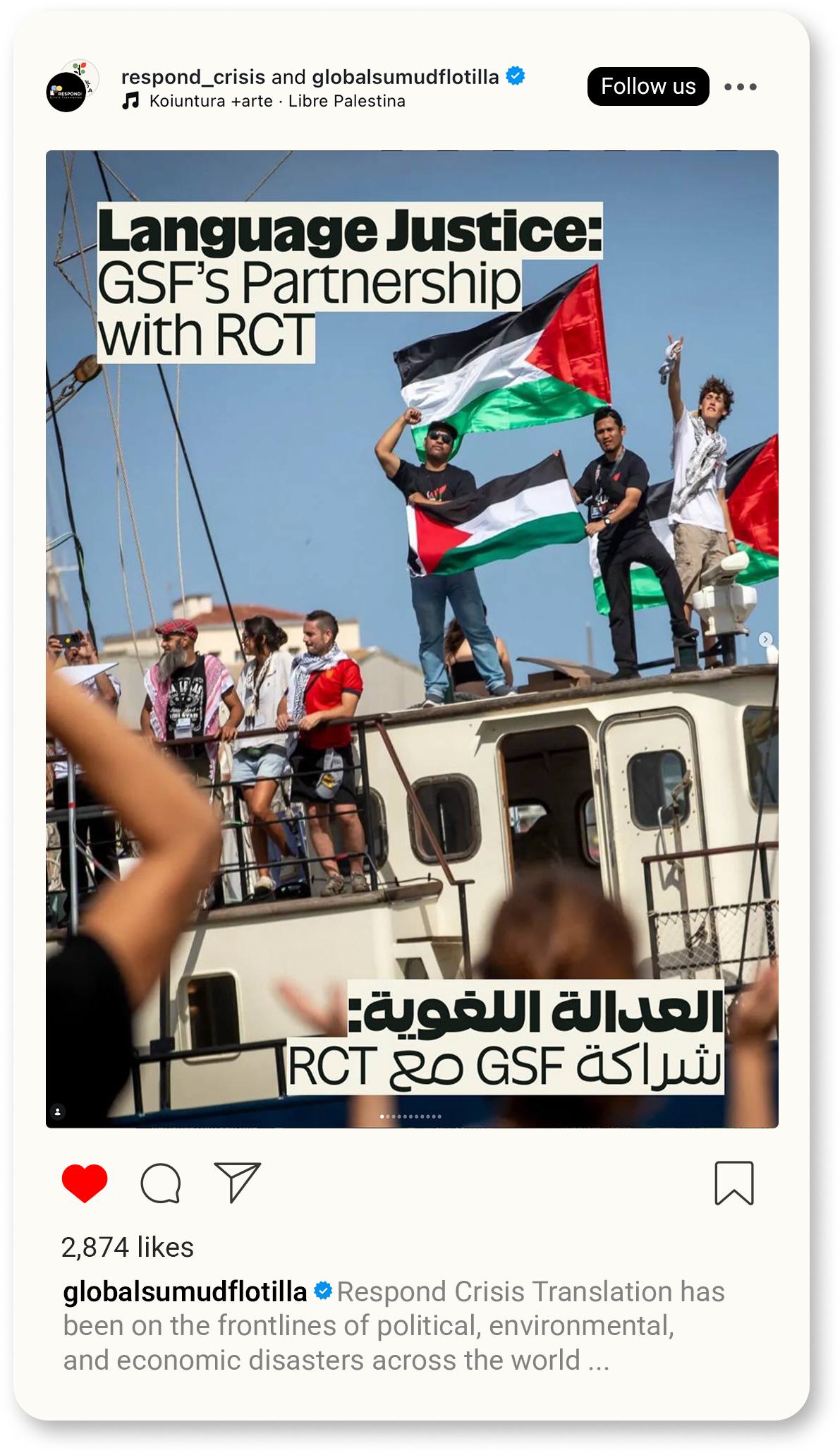
From March to May, we had the honour of providing written translation and interpreting services to the Global Sumud Flotilla Spring 2026 Sea Mission. This is a historic moment for the Palestine liberation movement as the flotilla is its largest yet, with over 500 participants and 50 boats. Our RCT translators and interpreters were an integral part of the mission: they translated over 44,000 words of online training materials into six languages: Arabic, Turkish, Spanish, French, Italian, and Greek, with a very tight deadline, covering every topic in the training from safety and security to roles and responsibilities, self-care, and the list goes on. We also provided over 250 hours of remote simultaneous interpreting into five languages, every day for the month of April. Over 90 linguists took part, either as translators, proofreaders or interpreters.
This was a momentous task, and the team certainly felt the effects of such a large-scale project. As Abdelbaar, one of the Arabic interpreters and part of the organizing team, put it: “The sleepless nights, long days, and endless calls trying to recruit interpreters on the one hand, and waking up early in the morning (which grew earlier the further east the Flotilla sailed) on the other were weary and tiring, but every time it felt like that, the memory and images of the daily plights of Palestinians in Gaza gave us more power and enthusiasm to carry on.”
“I am – and will forever be - so grateful and humbled for the opportunity to be part of such a heroic movement and work with people such as Thiago, Saif, and the thousands of others who are sacrificing their lives and freedom to break the inhumane siege on Gaza.”
Flotilla participants needed to undergo rigorous training as they prepared for the very real possibility that they would encounter violence from the occupying regime. We saw this possibility realized when, on April 30, 180 participants from the flotilla were illegally abducted by the occupiers and two were held in illegal detention in occupied Palestine for ten days. The occupying forces are known to inflict cruel and inhumane violence upon those they detain or intercept. Such a mission will never be safe–but the involvement of our interpreters and translators meant that participants who speak languages other than English know the safety, interception and detention protocol that could save their lives.
“At a time when the world feels overwhelming, being able to centre the Palestinian struggle, to say clearly and collectively that this matters, and being able to contribute to the heroic efforts of the flotilla team against the illegal siege conducted by an illegal state, felt not only important but necessary. It’s mainly but not only about Palestinians; it’s also about all of us, whether we accept the world as it is, or refuse to and fight to change it.” - Eyas, Arabic Team Lead
Respond School of Language Work: Gaza Pilot
Alongside our work with GSF, in January 2026, RCT launched an accredited semester-long training program in professional translation and interpreting for students in Gaza, in partnership with Jordan-based education academy Nell Academy.
The program includes 4 weeks of advanced English delivered by Nell Academy, followed by 12 weeks of translation and interpretation theory and practice, geared specifically towards training linguists to work in high-stakes, life-or-death legal and medical crisis situations, including asylum and detention contexts. Courses on project management, public speaking, and stress management are included in the curriculum. RCT is providing stipends to students in Gaza to facilitate access to computers, headsets, internet and learning spaces. Following the program, the students will have access to ongoing paid work opportunities through RCT.
The RCT community includes 12 translators based in Gaza, including the Co-Director of RCT’s Arabic team. Before October 7th, our team’s translators in Gaza were English professors, teachers, writers, journalists and university students. In the last 2 years, their schools and places of work were destroyed, while international aid organizations cut their programming and laid off staff in Gaza. In this void, RCT has been working to build infrastructure for dignified work for translators in Gaza, despite the brutal conditions. The Respond School of Language Work is the first step.
Multilingual Know Your Rights work
Another growing area of our work includes multilingual Know Your Rights projects. As organizers and collectives respond to the needs on the ground, we are ensuring that the communities they serve are able to access critical information in their own languages. Some of our recent projects have included translating ICE detention resource guides, the N-400 Naturalization Application into several marginalized languages, ICE raid safety documents, and flyers for Know Your Rights information sessions taking place across the country for vulnerable communities that speak low-resourced languages. In 2026 alone, we have worked on multilingual projects in over 30 languages, the majority of which was delivered pro bono for grassroots collectives and frontline organizers.
Eastern European and Central Asian Languages Team
At RCT, every successful outcome is a victory, and victories matter more than ever given the current moment. Most recently, we heard that after months of Respond’s Georgian translators and interpreters working tirelessly on a case in collaboration with Georgetown University Law Center, Mamuka (name changed for anonymity) and his family were granted asylum. Without the ability to testify and present evidence in his own language, Mamuka would have ended up like countless other asylum seekers whose cases are never heard due to the shortage of qualified, dialectical match interpreters. The access to trauma-informed language access made all the difference in the outcome of his case.
RCT’s Eastern European and Central Asian Languages team (EECA) responds to cases like Mamuka’s every day. In 2026 alone, the team has translated over 40,000 words, fighting for successful asylum outcomes for detained asylum seekers who speak Russian, Ukrainian, Chechen, Romanian, and many other languages.
Arabic Team
We also received news in February of a tremendous victory for a client our Arabic team had been supporting since 2024. Ahmed (name changed for anonymity) had been in immigration detention for over two years. His Respond interpreter was with him throughout the entire experience as his pro-bono legal team at RMIAN and his family fought to get him released from detention.
The support of an activist, trauma-informed interpreter in contexts like this simply cannot be overstated; they don’t just provide language services, they serve as a core part of the client’s support system–the client knows that there is someone on their side who speaks their language, who sees them for who they are, and who is committed to securing justice for them. Long-term detention cases like this should not happen. Nobody should spend years in detention. It was designed to be a short-term solution during processing–inhumane nonetheless, but temporary. However, increasingly, we are seeing cases like this, where due to the mishandling, prolongation and abuse of the carceral immigration system, individuals spend years behind bars. Part of our fight is ensuring that they do not have to endure this in silence.
Lost in AI-Mistranslation
Over the last several months, we have been working with an AI-ethics research team at the University of Frankfurt to create a survey collecting stories on how AI translation tools in asylum, immigration, and resettlement situations impacts asylum seekers, refugees, lawyers, psychologists, caseworkers, translators, interpreters, and all those involved in supporting throughout asylum and resettlement processes.
We would be so grateful for you taking the time to fill out this survey with stories of use of AI-translation tools and how these tools have impacted cases, both in terms of concrete mistranslations, as well as stress and emotional impacts of having to rely on these tools in high-stakes settings.
Here is the link to the survey: https://uva.fra1.qualtrics.com/jfe/form/SV_cD9h0xKZpk4TMRU
If you are able to share this out with your colleagues and community, or anyone in your network who might have had to rely on AI-translation tools in their work, this would be tremendously helpful!
If you are interested in reading further about our work on the ground combatting AI-generated mistranslations, please check out this short write-up on work combatting language rights violations in asylum processes.
If you have any questions, thoughts, or would be interested in chatting further about this research work, please reach out to meg@rct.org - she would be more than happy to chat!