Dear RCT Community,
Context: At RCT, we mobilize to ensure that anyone experiencing language as a barrier to safety or dignity has access to free, professional, trauma-informed translation and interpretation services. It may not surprise you that a large volume of the cases we take on involve LGBTQ+ individuals whose identity has meant they have been targeted, mistreated, or abused in their countries of origin. We work directly with individuals and also partner with trans and queer-specific legal aid organizations to support hundreds of queer immigrants and asylum seekers persecuted in their places of origin each year. Since 2022, we have worked on over 1,200 cases related to the LGBTQ+ community.
Using pride month as a pretext, we took some time to reflect on the state of the world while centering LGBTQ+ identities. This post was written by RCT members who identify as part of the LGBTQ+ community. It's a reflection on language work, on the impacts of increasing right wing sentiments and the consequences they have on queer migrants and on us as language workers. There are also some thoughts around the cruelty behind the myth of “safety” for queer individuals in the western world.
Before getting into it, let me add a disclaimer. In this piece I use the term queer and LGBTQ+ almost interchangeably. I don’t do this with the intention to invisibilize the beautiful range of identities, I use it as an umbrella term to make the post flow a bit more smoothly and because I personally like it. Let me also acknowledge that “queer” was a slur that has been reclaimed by the community. If anyone is offended by this, know that using it reflects my opinion, not that of my colleagues, and let it serve as a reminder that every act of naming is a choice. I also like “cuir” its hispanic spelling, but we’re not talking about that.
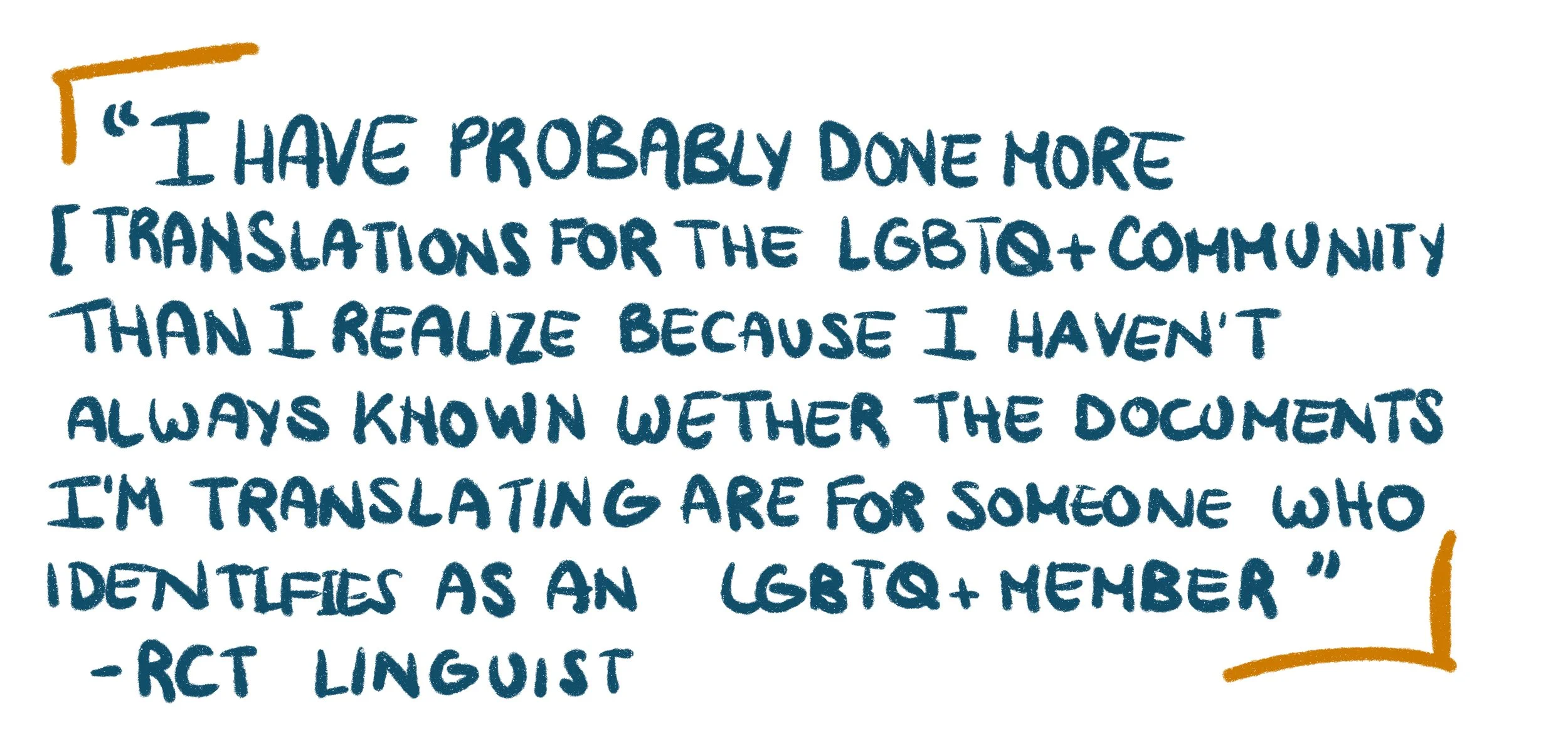
As language workers, we are always making choices, choices that inevitably will reflect our view of the world and unavoidably our own identity. Moreover, one can argue that translation and interpretation are themselves a form of knowledge production that bring new understandings into everyday life. For example Training team lead, Seren, who identifies as a lesbian and non-binary shared that they actively decide to use “gender-neutral language in Spanish even if it’s not requested” when they are interpreting. They think “it’s important to visibilise this language and non-binary and queer gender identities in all spaces, not just queer spaces” and with “[s]panish, gender-neutrality in language has necessitated neologisms which we have to work to build into the general lexicon.” Seren’s choice here is a step towards making gender-neutral language a more widely spread and acceptable practice.
In this work, particularly translating in asylum contexts and working in an occidental context, it is important to reflect on what choices we take while translating for the communities we serve. Sharing the example of translating the word “‘travesti’" into English, they said: “This term has been literally translated in the past as crossdresser or transvestite. However, those words don’t capture the true meaning – it’s essentially a distinct gender identity and I felt that translating it into English was to erase the identity of that community. I can’t say whether or not a cishet translator would or wouldn’t have done the same – I think many translators, queer or not, would keep the original, but it felt personal to me and like a loaded choice.”
Queerness exists in as many forms as individuals, but has been “popularized” under Western understandings. The urge to translate, to reduce “travesti” to a category that is conveniently understandable in the anglophone context, reflects one of the many difficulties of working for queer individuals seeking asylum in the West.
Asylum processes center two questions: “Does your identity put you at risk in your home country?” and “Do we believe that you are what you claim to be?”. Asylum processes do not consider economic background or access to a dignified life, which is a question for another time. The focus is placed squarely on identity and credibility, and as such queer people are forced to abide by pre-determined categories of what constitutes belonging to the LGBTQ+ community, and forces them to renounce the nuances and plurality of their own identity. All for the promise of safety and stability that the west markets, but does not necessarily grant.
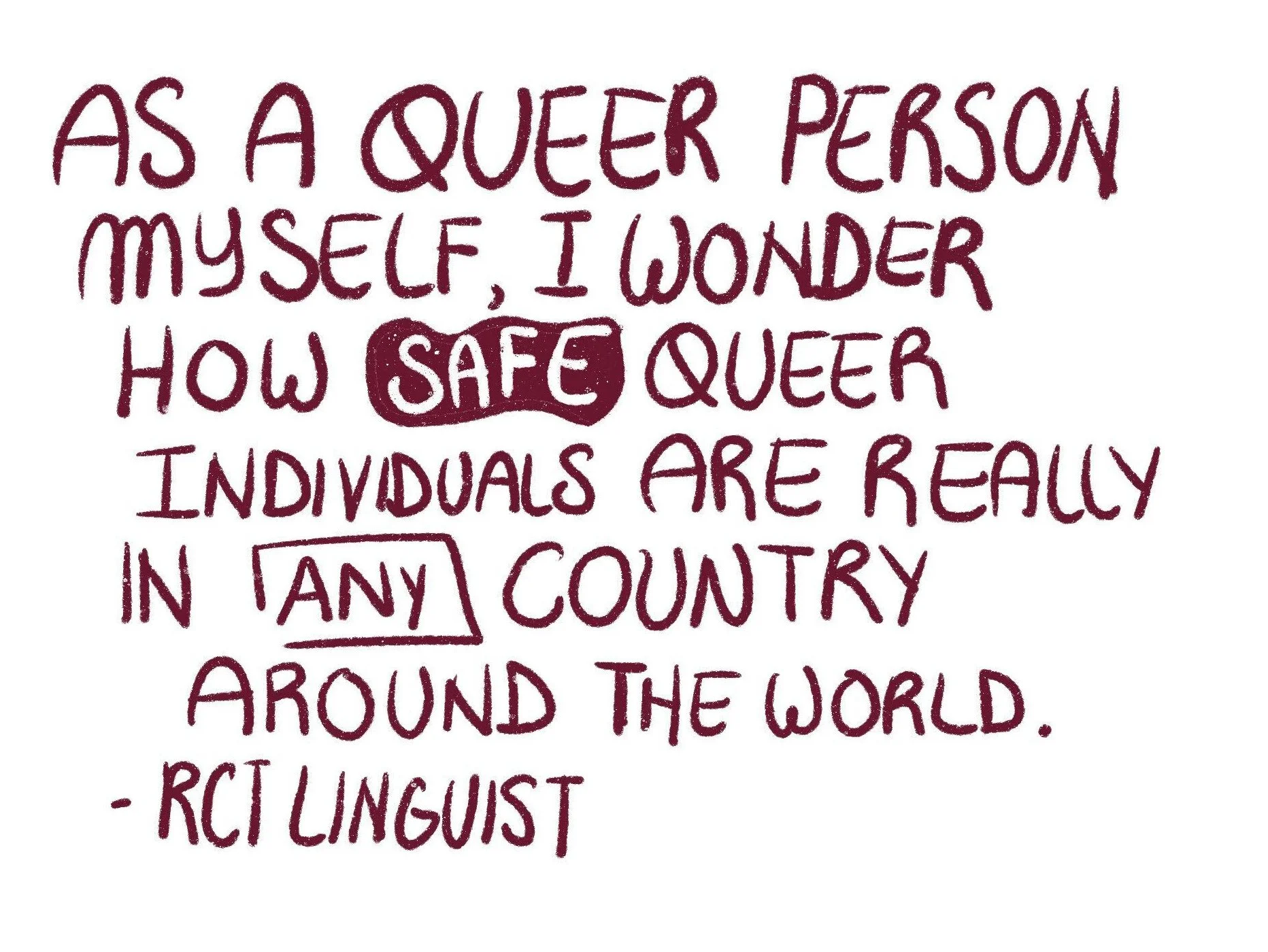
On this, Sheila, RCT’s trauma-informed care consultant, shares: "It's been a very confusing landscape for queer migrants and asylum-seekers, because while there's a facade of "equality" and "acceptance" in the global North, we also know that our trans siblings are being targeted by the Trump administration.” Similarly for the UK, Seren narrates: “A queer asylum seeker may be coming to the UK with the hope that they will be protected, that they can access a future different to that which would be given to them in their home country… and this is what they arrive to – riots in the streets shouting ‘foreigners out’, and anti-LGBTQ+ laws in Parliament.”
Acceptance into the West comes with fitting a particular mold that is supposed to represent an universal experience of queerness, but actually means a white, occidental experience. Thus, the asylum process simplifies the experiences of queer beings and repackages them to fit the imaginary narrative that appeals to western sympathy – a classic trait of western paternalism and saviorism–: as “helpless victims” that need protection.
The “victim” stereotype exists for any individual seeking asylum. Putting people into that narrative neglects asylum seekers' opinions and analysis about their own situation, their positionality in relation to their places of origin, and any feelings or views they might have about the place they currently find themselves in. Furthermore it creates this myth that constant suffering must follow the life of an asylum seeker for them to be worth protecting.
As shared by Sheila “there's this way in which nonprofits like to portray queer asylum-seekers as helpless victims. Let me tell you, they are not.” People deserve international protection from violence, homophobic violence, economic violence or any other. And people should not need to make themselves small into an identity that deems them worthy of said protection to receive it. When working in situations of such power inequality, we might commit the mistake of reducing people to the obstacles they face. Don’t make that mistake. Individuals are fully fledged beings with their own plural experiences. Sheila, who also works as a therapist shares: “Queer people are funnyyyyyyyy. Yes, the material clients bring to therapy is often painful and sometimes even horrifying, but [m]y queer clients will deliver searing political analysis of Our Current Political Moment on a bed of humor that I actually can't repeat in a work blog post.”
The wish behind this post is to shed light on some of the specificities of the struggles that queer asylum seekers face, not to reduce their resilience, nor the beauty that our identity invites. “Being queer and working with queer people makes you think expansively about family and connection” Sheila says, and continues: “[My identity] impacts everything about my work. It makes me think creatively because none of these systems were built for us, or with us in mind. It helps me slow down and find every opportunity for repair that I can. It helps me share with non-queer clients ways in which care can take many forms, and that things don't have to stay static in their broken state.”
How can we, LGBTQ+ individuals and anyone committed to abolishing injustice, use our creativity and imagine expansive ways to create a kinder future? ?
Thank you, Seren, Sheila and anonymous contributors for lending your words to this reflection. Thank you all for reading.
With love,
Bosé