
RCT featured in the San Francisco Examiner: Felipe’s Story, and the Story of RCT
In this feature story, reporter Troy Wolverton begins with the case of Felipe, a farmworker organizer who fled Colombia three years ago, due to threats from armed gangs. When Felipe encountered multiple obstacles to obtaining an interpreter for his asylum hearing, Respond Crisis Translation stepped in to help, accompanying Felipe throughout the process–from the interview, to seeking out required service provision, through the preparation of needed documents. Felipe won his asylum case and is a member of the RCT community today.

“Felipe is just the latest person Koren and her six-year-old organization have helped. RCT pairs people in need of spoken interpretation or written translation with those in need of such services. Just this year, RCT has provided language services in 15,000 cases.”

The article goes on to tell the origin story of this remarkable organization that has built a network of some 3,000 interpreters and translators around the world who represent 200 languages. From watching her deaf, disabled sister’s experience of psychiatric abuse, Koren developed a critical perspective on communications deprivation as a “form of torture.” Meanwhile, Koren worked with Google Translate, and became a whistleblower who exposed their policies of collaborating with police and ICE, while substituting machine translation for the needed human element in life-and-death circumstances of crisis translation.
As the SF Examiner writes:
“Koren said that in its work, RCT has been able to stop 30 to 40 deportation efforts that were a result of language errors.
‘Having a qualified language worker, a qualified interpreter or translator, is make or break,’ she said.
‘It could be the difference between freedom and being sentenced literally to detention, deportation— and in many cases, that means death,’ she said.”
You can read the original article here.
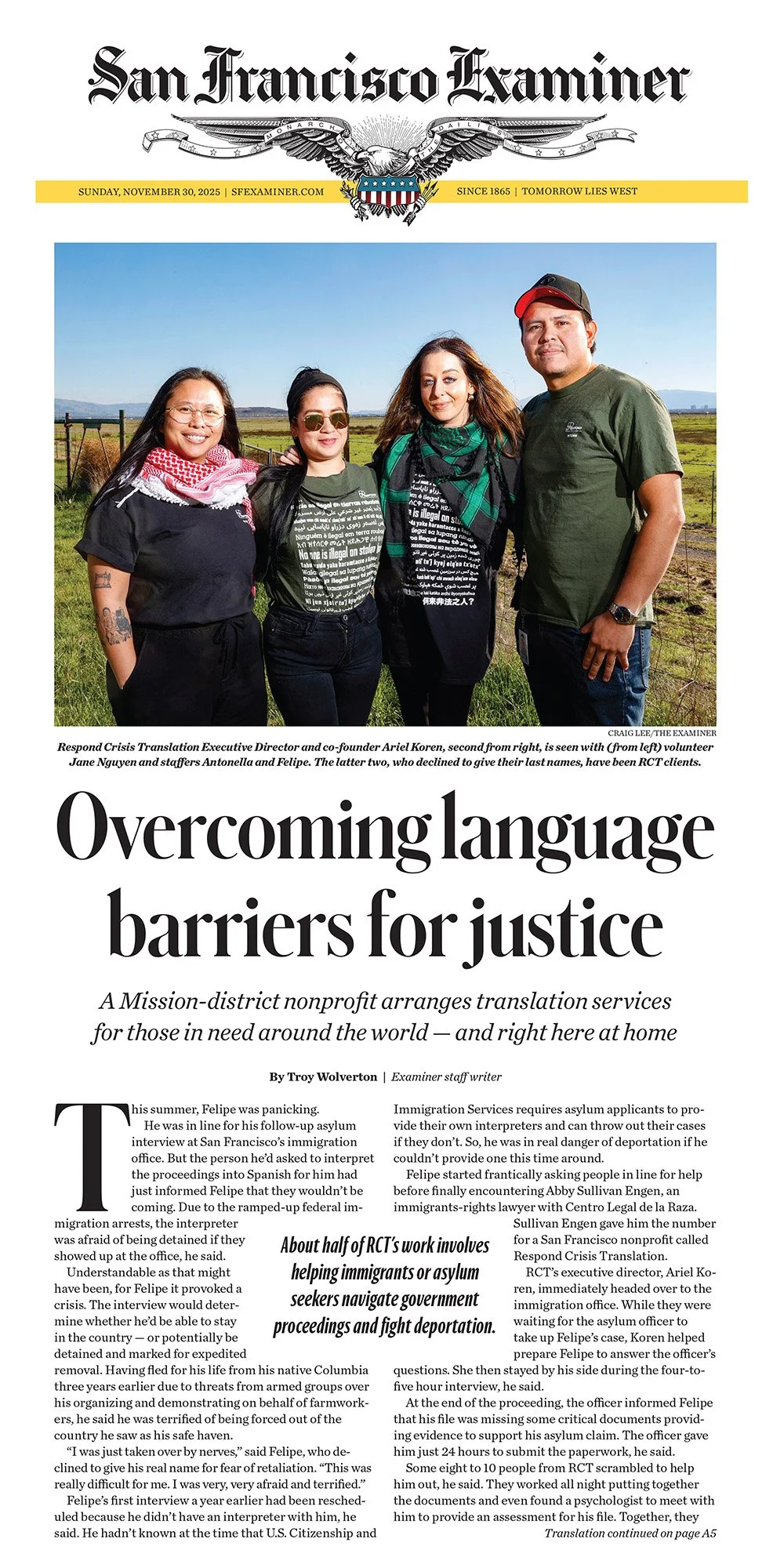
This SF nonprofit translates for tasks big and small
By Troy Wolverton | Examiner staff writer
This summer, Felipe was panicking.
He was in line for his follow-up asylum interview at San Francisco’s immigration office. But the person he’d asked to interpret the proceedings into Spanish for him had just informed Felipe that they wouldn’t be coming. Due to the ramped-up federal immigration arrests, the interpreter was afraid of being detained if they showed up at the office, he said.
Understandable as that might have been, for Felipe it provoked a crisis. The interview would determine whether he’d be able to stay in the country — or potentially be detained and marked for expedited removal. Having fled for his life from his native Columbia three years earlier due to threats from armed groups over his organizing and demonstrating on behalf of farmworkers, he said he was terrified of being forced out of the country he saw as his safe haven.
“I was just taken over by nerves,” said Felipe, who declined to give his real name for fear of retaliation. “This was really difficult for me. I was very, very afraid and terrified.”
Felipe’s first interview a year earlier had been rescheduled because he didn’t have an interpreter with him, he said. He hadn’t known at the time that U.S. Citizenship and Immigration Services requires asylum applicants to provide their own interpreters and can throw out their cases if they don’t. So, he was in real danger of deportation if he couldn’t provide one this time around.
Felipe started frantically asking people in line for help before finally encountering Abby Sullivan Engen, an immigrants-rights lawyer with Centro Legal de la Raza. Sullivan Engen gave him the number for a San Francisco nonprofit called Respond Crisis Translation.
RCT’s executive director, Ariel Koren, immediately headed over to the immigration office. While they were waiting for the asylum officer to take up Felipe’s case, Koren helped prepare Felipe to answer the officer’s questions. She then stayed by his side during the four-to-five hour interview, he said.
At the end of the proceeding, the officer informed Felipe that his file was missing some critical documents providing evidence to support his asylum claim. The officer gave him just 24 hours to submit the paperwork, he said.
Some eight to 10 people from RCT scrambled to help him out, he said. They worked all night putting together the documents and even found a psychologist to meet with him to provide an assessment for his file. Together, they were able to meet the deadline.
Fifteen days later, Koren was with Felipe when he went back to the immigration office. The asylum officer informed Felipe his asylum claim had been approved.
“If it weren’t for the dedication and the rapid mobilization of this organization, I just don’t even think I would be standing here today with the privilege of having my status here in this country,” said Felipe, whose comments in Spanish to The Examiner were interpreted by Koren.
Felipe is just the latest person Koren and her six-year-old organization have helped. RCT pairs people in need of spoken interpretation or written translation with those in need of such services. Just this year, RCT has provided language services in 15,000 cases, according to Koren.
Over the years, the organization has built a network of some 3,000 interpreters and translators around the world who represent 200 languages, she said. Although about half of RCT’s work involves helping immigrants or asylum seekers such as Felipe navigate government proceedings and fight deportation, RCT also provides interpreters and translators to help people navigate daily life, she said.
Its language-service providers help people communicate with potential employers, health-care providers and the schools their children attend, Koren said. It even helped one asylee put together the licensing paperwork she needed to launch her catering business, Koren said.
“We don’t just do emergency acute language work,” she said. “We also do long-term accompaniment work.”
Koren said she was inspired to found RCT in part by a language-related tragedy experienced by her sister, who is deaf and has a mental disability. At one point, when her sister was experiencing a crisis, people nearby called law enforcement because they were unable to communicate with her, Koren said. Her sister ended up being arrested, then hospitalized or institutionalized for nearly two years, she said.
Her sister’s health deteriorated during that time, in part because she struggled to communicate with people, Koren said.
“Communications deprivation is truly one of the most horrible things that people can go through,” she said. “It really should be referred to as torture.”
At about the same time her sister was going through this experience, Koren — who said she speaks nine languages — was working for Google Translate. She said that while there, she noted the service was being used by federal government agencies such as Immigration and Customs Enforcement and Customs and Border Patrol in high-stakes, even life-threatening situations.
Koren said she felt that was dangerously inappropriate. Google Translate was neither fast nor precise enough to be used in such situations, she said — and it wasn’t human. It didn’t have the empathy to understand the trauma experienced by people in those positions.
“People going through a life-threatening or just any medical situation or ... getting the determination of whether or not they’re going to be given asylum — that should not be happening while you’re using a machine-translation tool,” she said.
Koren protested to Google about the use of Google Translate in such situations, but her objections were met with retaliation, she said. She ended up resigning from the company in 2022 — in part over that and in part over what she viewed as the company’s retaliation against her for organizing against Google’s effort to provide artificial-intelligence tools to the Israeli military.
According to The New York Times, Google said at the time of Koren’s resignation that it prohibits retaliation and that it had investigated her claim but wasn’t able to substantiate it.
But on RCT’s board are two other former Google dissidents and whistleblowers who also said the company retaliated against them: AI researchers Timnit Gebru and Alex Hanna.
“It’s not a coincidence that we have these folks on our board,” Koren said.
Koren said that between her sister’s experience, what she observed with Google Translate and her own work as a crisis interpreter, she saw a broad need for language services. She said she also saw how the lack of such services — or the absence of adequate ones — was being used as a weapon against those who needed them.
Not only could asylum seekers have their claims denied if they didn’t bring along interpreters, but mistranslation happened all too frequently. Asylum seekers and immigrants were being pressured to participate in proceedings or sign documents in languages they didn’t understand — often with life-changing consequences.
Koren said that in its work, RCT has been able to stop 30 to 40 deportation efforts that were a result of language errors.
“Having a qualified language worker, a qualified interpreter or translator, is make or break,” she said.
“It could be the difference between freedom and being sentenced literally to detention, deportation — and in many cases, that means death,” she said.
RCT provides its language services for free to individuals in need of them. Although some of its interpreters, translators and office workers are volunteers, Koren is adamant that language work is valuable and should be paid for accordingly. And while there’s a dearth of language workers around the world, she said that’s a function not of a lack of talent but economics.
“Systemically, there is not a liveable industry for translators and interpreters,” she said.
Her nonprofit — which has 16 employees, including three in the Bay Area — works with more than 600 organizations around the world. It charges some of the larger organizations it works with — including UNICEF and the Office of the U.N. High Commissioner for Refugees — for its translation services, she said, and it also seeks out grants to fund its work and pay language workers.
Many of RCT’s paid interpreters are themselves the victims of trauma or in difficult situations. The organization has a large group of people working for it in Afghanistan, she said. Some are former translators for the U.S. forces during the war there who couldn’t find a job otherwise. Others are women who have been excluded from education and other opportunities by the Taliban regime.
“Respond Crisis Translation became kind of a hub for people who could, instead of whatever they [had been] studying, go into translation work,” Koren said.
Jane Nguyen said she began volunteering with RCT this summer because she had seen up close how large a barrier language can be. An Oakland resident who came to the U.S. from Vietnam as a child in 1992, Nguyen witnessed her family members struggle to find jobs or even pay bills because of their lack of skill with English, she said.
In her work for RCT, she’s helped organize events and coordinated translation and interpretation projects. She said she’s also working on translating a children’s book about climate disasters into Vietnamese.
Nguyen said she’s been very impressed with the organization.
“I think it’s incredible, very important work,” Nguyen said.
Sullivan Engen saw up close RCT’s work with Felipe, as well as another case of a migrant who was arrested and threatened with deportation. She said RCT was able to secure her release, and she she came away impressed by Koren, RCT and how the organization approaches language work.
Koren didn’t just robotically interpret, but was able to highlight nuances in translation that can be crucial in asylum cases, she said.
“I felt like she really opened my eyes to this world of interpretation that goes beyond what I’ve seen in the court — and been so frequently disappointed by,” Sullivan Engen said.